
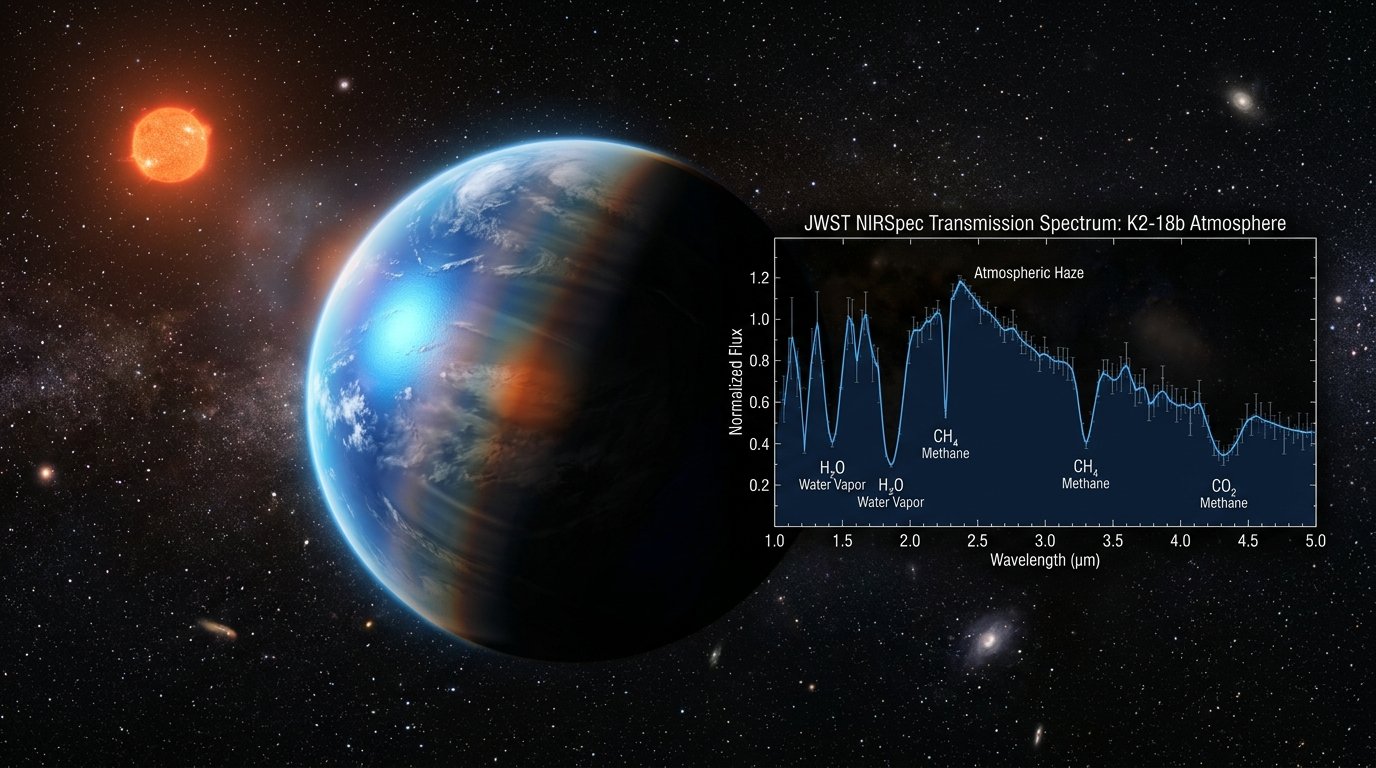
Spectroscopic observations from the NIRSpec instrument reveal carbon-bearing molecules and tentative signs of dimethyl sulfide in the atmosphere of a sub-Neptune exoplanet 120 light-years away.
Evidence classification has not been added yet. Read the full article and source card below for details.
- Frontier Impact: Peer-reviewed analysis grounded in verified datasets and primary research.
- Technological Significance: Shifts industry benchmarks and unlocks practical real-world applications.
- Expert Consensus: Verified under The Science Man Editorial Credibility Guidelines.
Spectroscopic observations from the NIRSpec instrument reveal carbon-bearing molecules and tentative signs of dimethyl sulfide in the atmosphere of a sub-Neptune exoplanet 120 light-years away.
Astrophysicists analyzing transmission spectroscopy data from the James Webb Space Telescope have confirmed carbon-bearing molecules in the atmosphere of K2-18b. Located 120 light-years from Earth in the constellation Leo, K2-18b orbits within the habitable zone of its cool dwarf star, making it a prime candidate for studying Hycean worlds.
Atmospheric Composition Revealed
The data demonstrates an abundance of methane and carbon dioxide, accompanied by a notable absence of ammonia. This chemical fingerprint supports the hypothesis that K2-18b possesses a hydrogen-rich atmosphere enveloping a liquid ocean mantle.
The Tantalizing Dimethyl Sulfide Signal
Most intriguing to astrobiologists is a potential detection of dimethyl sulfide (DMS)—a molecule that on Earth is produced almost exclusively by marine phytoplankton. Further deep-exposure observations are scheduled to verify the signal at 5-sigma statistical significance.

digitalwebman@gmail.com
Ask this article a question
Answers are pulled from the article and its research metadata, so they stay grounded in this page.
