

Discover why Henri B. Kagan and Kenso Soai won the 2026 Nobel Prize in Chemistry, how molecular handedness works, and what their research means.
Evidence classification has not been added yet. Read the full article and source card below for details.
- Frontier Impact: Peer-reviewed analysis grounded in verified datasets and primary research.
- Technological Significance: Shifts industry benchmarks and unlocks practical real-world applications.
- Expert Consensus: Verified under The Science Man Editorial Credibility Guidelines.
Discover why Henri B. Kagan and Kenso Soai won the 2026 Nobel Prize in Chemistry, how molecular handedness works, and what their research means.
Introduction
On a laboratory bench, two molecules can contain the same atoms, the same bonds and the same formula—and still behave differently because one is the mirror image of the other. That small difference in three-dimensional shape can decide how a molecule interacts with an enzyme, a cell or another chemical. It is one reason chemists have spent generations learning how to make the desired molecular form reliably.
The 2026 Nobel Prize in Chemistry brings this challenge into focus. Henri B. Kagan and Kenso Soai were recognised for discoveries concerning non-linear effects and autocatalysis in asymmetric organic synthesis. Their work helps explain how a reaction can favour one molecular “hand” over its mirror counterpart, and how a small imbalance can sometimes grow dramatically. The subject reaches from practical synthesis to a much older scientific puzzle: why life on Earth uses particular molecular forms so consistently.
This guide explains the award in plain English, separates established chemistry from open questions about life’s origins, and looks back at the Chemistry Nobel laureates from 2017 through 2026. The central idea is simple to picture, even when the chemistry behind it is subtle: a mirror image is not always an interchangeable partner.
Nobel Prize in Chemistry 2026: at a glance
| Detail | Verified information |
|---|---|
| Award | Nobel Prize in Chemistry 2026 |
| Laureates | Henri B. Kagan and Kenso Soai |
| Awarded for | Discovery of non-linear effects and autocatalysis in asymmetric organic synthesis |
| Announcement | 7 October 2026 |
| Awarding body | The Royal Swedish Academy of Sciences |
| Main subject | How chemical reactions can favour and amplify one mirror-image form of a molecule |
| Prize amount | 12 million Swedish kronor in total, shared between the laureates, according to the official Nobel announcement |
The official Nobel Prize page and its scientific background are the primary references for the award’s motivation and technical context. News coverage can help explain the announcement, but the Academy’s wording is the source of record.
Who won the Nobel Prize in Chemistry 2026?
The award went to two chemists whose contributions illuminate different but connected parts of asymmetric synthesis. Kagan’s work helped chemists understand how the “handedness” of a catalyst can influence the handedness of the products it helps make. Soai’s research demonstrated a striking form of asymmetric autocatalysis: a chiral product can help catalyse its own formation, allowing a small preference to become much larger under suitable conditions.
Henri B. Kagan
Henri B. Kagan is a French chemist associated with the development of asymmetric catalysis and organic synthesis. His research helped turn molecular chirality from a structural observation into something chemists could control in a reaction. A major part of the story is the non-linear effect: under certain conditions, the enantiomeric composition of a product can be more strongly biased than the enantiomeric composition of the catalyst mixture might lead a beginner to expect.
That is not a general rule that every catalyst mixture behaves this way. The result depends on the reaction system, how catalyst molecules associate, and how efficiently different catalyst forms produce product. Kagan’s contribution gave chemists both experimental examples and a framework for interpreting these relationships. It expanded the practical question from “Which catalyst is chiral?” to “How does the catalyst mixture translate into the product mixture?”
Kenso Soai
Kenso Soai is a Japanese chemist whose research on asymmetric autocatalysis became known through the Soai reaction. In the best-known form of this work, the product of a reaction can act as a catalyst for making more of itself. When the product is chiral, one molecular form can promote the formation of additional molecules of that same form.
This feedback-like behaviour is chemically unusual and scientifically useful. It gives a mechanism by which a very small initial imbalance can be amplified. Soai’s experiments showed that asymmetric autocatalysis could produce a strong preference for one enantiomer, even when the starting point did not contain a large excess of one handed form. The reaction became an important model system for studying how chirality can emerge and grow in chemical processes.
Kagan and Soai did not answer every question about why life is one-handed. Their work clarified chemical routes through which asymmetry may be generated or amplified, while leaving open how those routes operated on the early Earth and how biological systems later selected and maintained particular molecular forms.
What did the 2026 Chemistry Nobel recognise?
The award recognises discoveries about non-linear effects and autocatalysis in asymmetric organic synthesis. To unpack that sentence, begin with synthesis: chemists build molecules through sequences of reactions. “Asymmetric” synthesis aims to make one of two mirror-image forms more than the other. “Organic” refers to carbon-based chemistry, the broad area that includes many molecules used in biology, medicines, polymers and everyday materials.
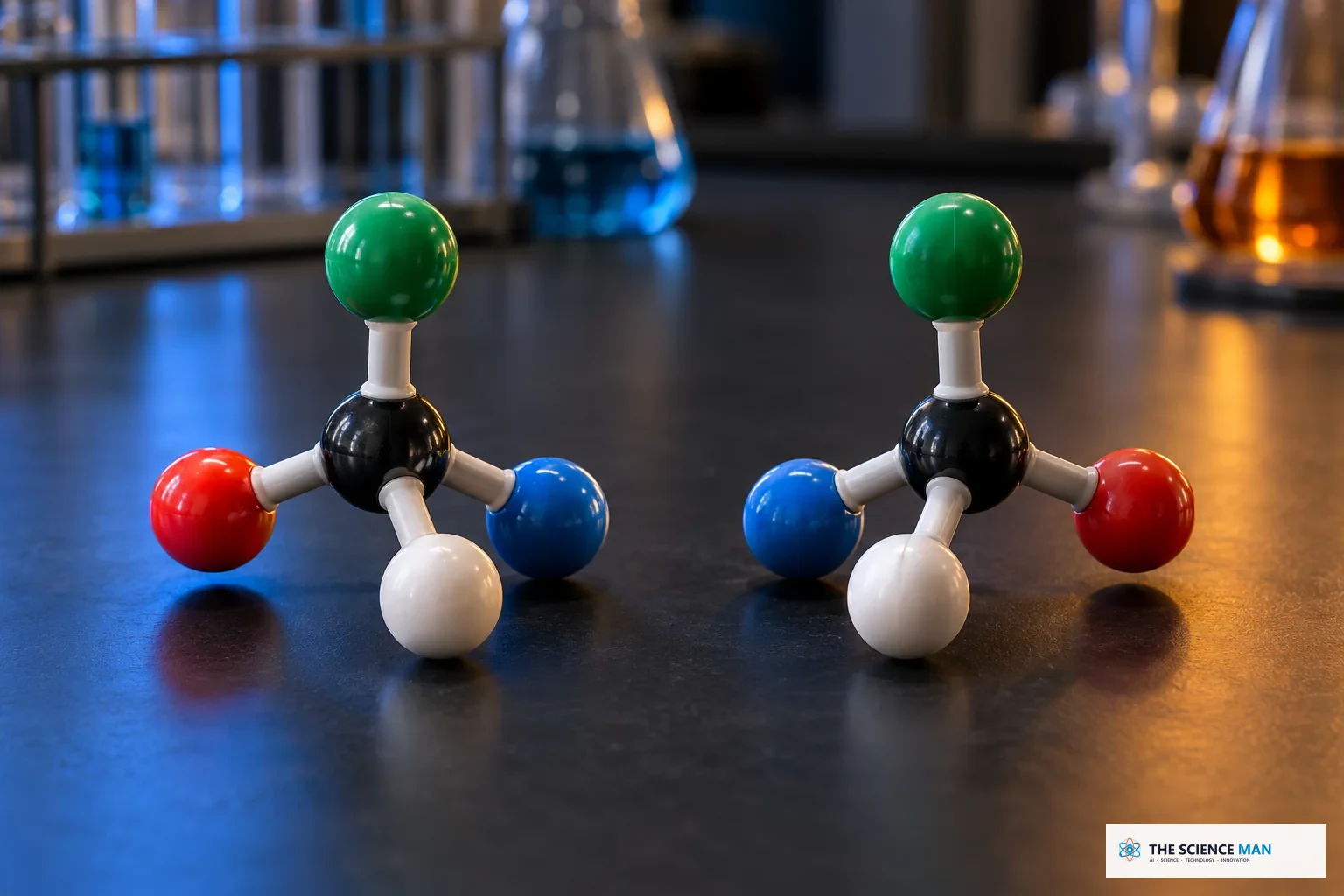
The mirror-image forms are called enantiomers. A simple analogy is a pair of gloves. A left glove and a right glove may look almost identical, but they cannot be rotated into a perfect match. Chiral molecules have a similar relationship: their mirror images cannot be superimposed exactly. They contain the same atoms connected in the same order, yet those atoms point in different directions in three-dimensional space.
In a chemical reaction, producing both enantiomers equally can be wasteful or undesirable. A catalyst may help a reaction proceed faster, but a chiral catalyst can also create an environment that favours one orientation over another. A reaction that preferentially produces one enantiomer is called enantioselective.
The Nobel-recognised work added two important insights. First, the relationship between the chirality of a catalyst mixture and the chirality of its product can be non-linear. Second, in an autocatalytic reaction, a product can assist its own production. Together, these ideas show how molecular bias can be amplified rather than merely copied.
The science behind molecular handedness
1. A molecule can have a left and a right form
Chirality appears when a molecule’s three-dimensional structure lacks a plane that divides it into two matching halves. In many familiar examples, a carbon atom is attached to four different groups. The resulting arrangement can exist in two mirror-image forms.
Chemists often describe these forms as left-handed and right-handed, although the formal labels used for molecules are more precise than simply “left” and “right.” The important point is that the two forms are related as mirror images but are not interchangeable in a chiral environment.
2. Biological systems can distinguish the two forms
Proteins, enzymes, receptors and DNA are themselves built from molecules with specific three-dimensional arrangements. A molecule that fits an enzyme in one orientation may fit poorly in its mirror form—just as a right hand fits a right glove better than a left glove. The two enantiomers may therefore differ in how they bind, react, smell, taste or affect a biological pathway.
This does not mean that every pair of enantiomers has radically different effects. Their properties depend on the molecule and the system being studied. It does mean that stereochemistry—the three-dimensional arrangement of atoms—can be essential to understanding a molecule’s behaviour.
3. Catalysts guide the reaction’s route
A catalyst provides a route for a reaction to happen more readily without being consumed overall. In asymmetric catalysis, the catalyst’s own chiral shape can make one pathway easier than its mirror alternative. The product mixture then contains more of one enantiomer.
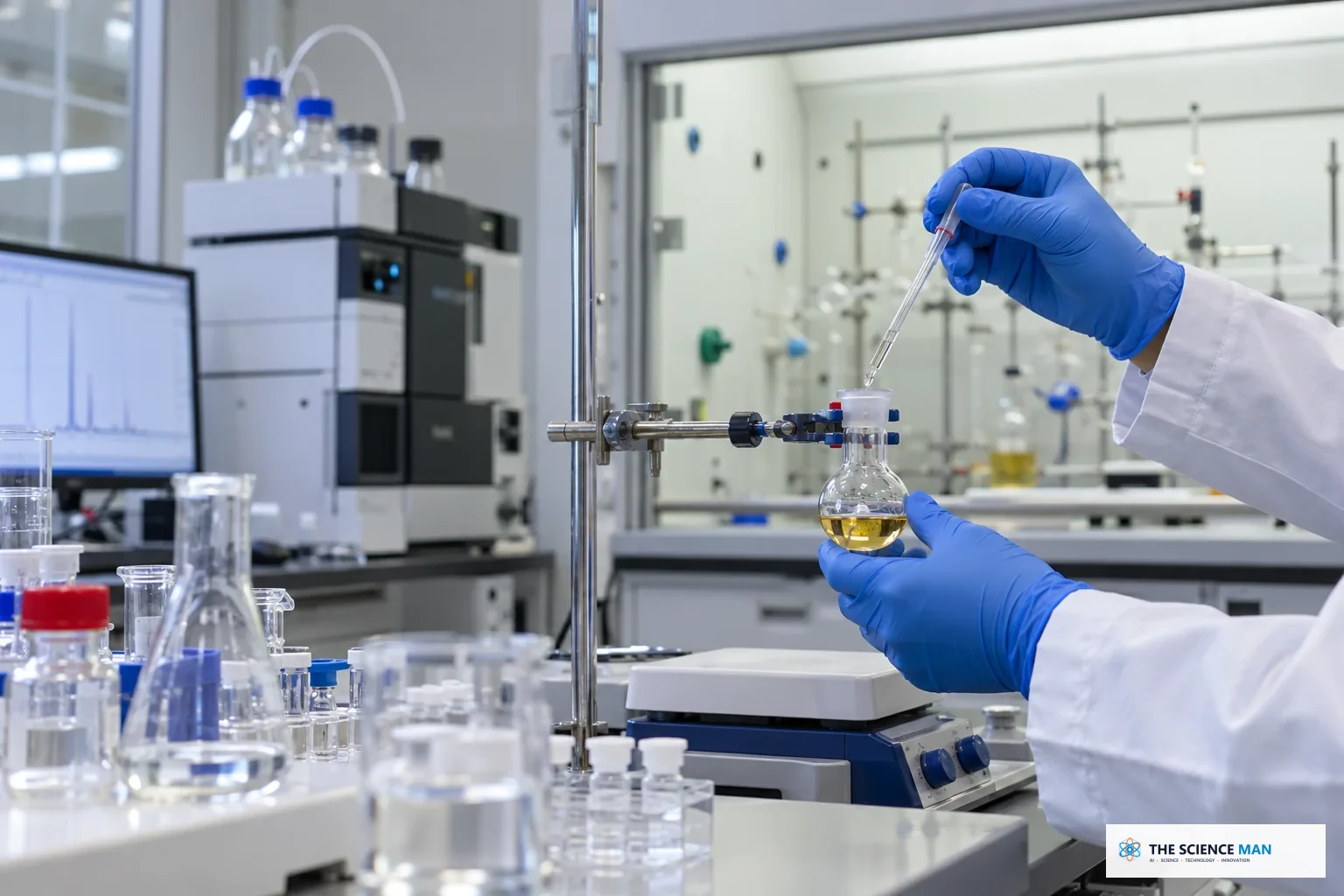
The final balance is often described using enantiomeric excess, or ee. If a product mixture contains 70 per cent of one enantiomer and 30 per cent of the other, the excess is 40 per cent. The measurement summarises the difference between the two amounts; it does not say that the reaction produced only one form.
4. Non-linear effects change the expected relationship
In a simple mental model, a catalyst mixture with a small excess of one hand might be expected to produce a product with a similarly small excess. But catalysts do not always act as isolated, independent particles. They can associate with one another, form aggregates, or participate in pathways whose efficiencies differ.
When those details matter, the product’s enantiomeric excess may not scale in a straight line with the catalyst’s enantiomeric excess. A modest catalyst imbalance can sometimes yield a larger product imbalance. That amplification is called a non-linear effect. The word “non-linear” describes the shape of the relationship, not a mysterious force or a universal property of chiral reactions.
This insight gave chemists a way to interpret why some asymmetric reactions behave more selectively than a basic one-to-one model predicts. It also highlighted the importance of studying a complete reaction system: catalyst structure, concentration, solvent, temperature and molecular association can all influence the result.
5. Autocatalysis lets a product help make more product
In an ordinary catalytic reaction, a separate catalyst helps transform starting materials into products. In an autocatalytic reaction, a product also acts as a catalyst for the reaction that forms more of that product. The product therefore participates in a reinforcing cycle.
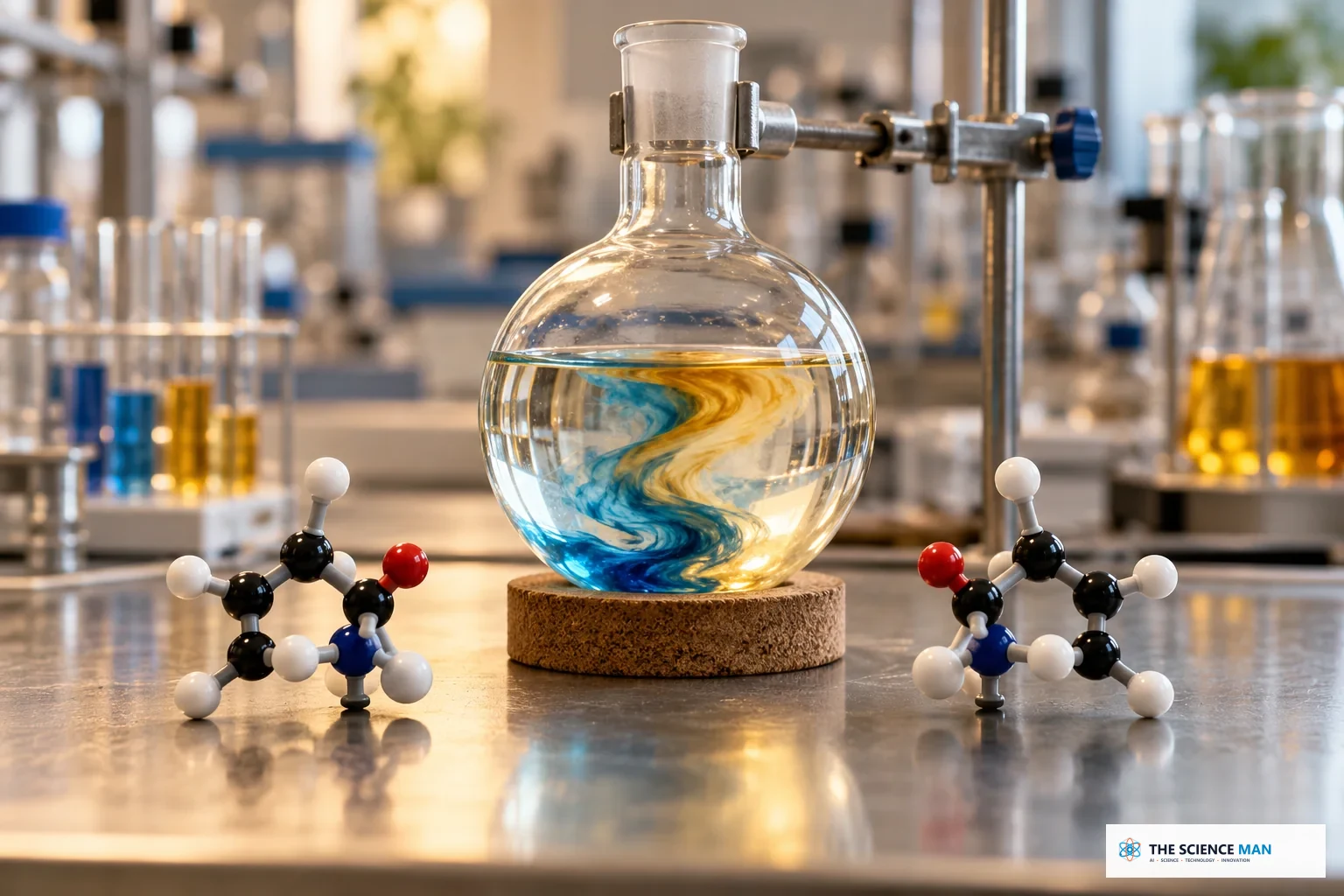
Imagine the first product molecules as a few seeds in a tray. If each seed helps produce more seeds of the same type, the initial difference can grow. In a chiral autocatalytic process, a small excess of one enantiomer can promote formation of more of that enantiomer. Repeating the cycle can increase the imbalance.
The analogy is useful but incomplete. A chemical reaction is governed by molecular encounters, rate constants, concentrations and conditions—not by a conscious choice or a self-replicating organism. The reaction does not create matter from nothing. It changes how reactants are converted into products.
6. The Soai reaction became a model system
The Soai reaction is studied because it displays asymmetric autocatalysis in a clear and unusually powerful way. It involves a carbon–carbon bond-forming reaction in which a chiral product can catalyse formation of more product with the same handedness. Researchers have tested how small initial biases, including subtle chiral influences, can affect the outcome.
The reaction’s importance is not that it reproduces the chemistry of life in a flask. It is that it gives scientists a controlled system for asking how a small preference can be amplified. Model systems let researchers isolate a mechanism and vary conditions in ways that would be difficult in a complex living cell or on a young planet.
7. Amplification is not the same as origin
One of the biggest questions in prebiotic chemistry is how life came to rely so consistently on particular molecular forms. Proteins use L-amino acids, while biological nucleic acids use D-sugars. This broad preference is often discussed as homochirality.
Autocatalysis and non-linear effects offer plausible chemical mechanisms for generating or magnifying asymmetry. But a mechanism that can amplify a bias does not by itself identify the original source of that bias, show that the same reaction occurred on early Earth, or explain how primitive chemical networks became biological systems.
The Nobel-recognised research is therefore a meaningful piece of the puzzle, not a complete answer to the origin of life. That distinction keeps the science exciting without turning an open research question into a settled fact.
Why was this discovery important?
Before highly selective asymmetric methods became widespread, chemists often faced a difficult choice: make a mixture of mirror-image molecules and separate them later, or search for a reaction that would favour the desired form from the beginning. Separation can require extra steps, materials and energy. It can also reduce the amount of usable product.
Asymmetric synthesis made it possible to direct reactions toward a chosen molecular form. Kagan’s work on non-linear effects helped chemists understand why a chiral catalyst can sometimes generate a stronger product bias than a simple proportional model predicts. Soai’s work showed how a chiral product could participate in amplifying its own formation. These findings offered both practical strategies and deeper ways to think about how chemical asymmetry develops.
The broader lesson is that a small molecular preference may have consequences far beyond its initial size. In biology, the shape of a molecule affects recognition and reaction. In synthesis, it can affect selectivity, process design and what compounds are available for downstream research. In fundamental chemistry, it raises questions about how order and asymmetry can emerge from reactions that begin with little or no obvious preference.
The work also connects several areas that are often taught separately: catalysis, reaction kinetics, stereochemistry, organic synthesis and origin-of-life research. The connection is intellectually powerful because the same principles—molecular fit, reaction pathways and amplification—can be investigated with different scientific questions in mind.
How could this chemistry change research and industry?
The research has two kinds of significance: established influence on chemical synthesis and continuing possibilities for future work. These should not be confused. A reaction that is scientifically important does not automatically become a commercial manufacturing process, and a Nobel Prize does not certify a specific medicine or industrial product.
Pharmaceutical and medicinal chemistry
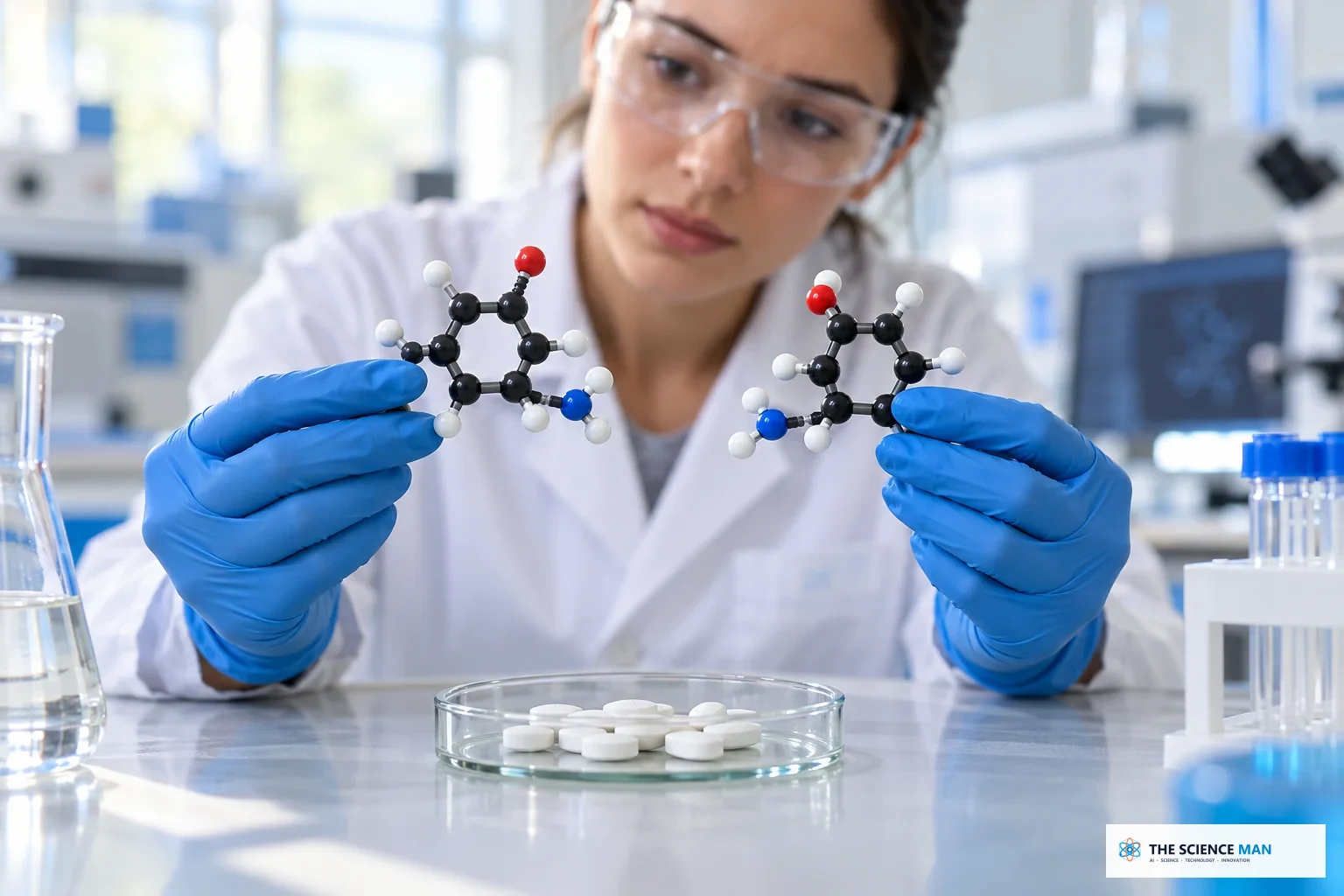
Drug molecules often interact with proteins and other chiral structures in the body. For that reason, medicinal chemists study the stereochemistry of candidate molecules early in research and development. Asymmetric synthesis provides methods to make the desired stereoisomer selectively, while analytical chemistry verifies what was produced.
The Nobel-recognised concepts contribute to the broader toolkit chemists use to control stereochemistry. The direct value of any particular method depends on the target molecule, cost, yield, safety, reproducibility and regulatory requirements. The research should not be read as a claim that a new medicine has already emerged from the award-winning reactions.
Fine chemicals and complex molecule synthesis
Many compounds used in research, fragrances, flavours, crop protection and specialty materials have complex three-dimensional structures. Selective synthesis can simplify routes to such molecules. A better understanding of non-linear effects may help chemists choose catalyst compositions and reaction conditions more intelligently, rather than treating selectivity as a black box.
Catalysis research
Catalysis remains central to making chemical reactions faster, more selective and less resource-intensive. The 2026 work encourages researchers to examine how catalysts interact and how products influence reaction pathways. Such understanding can guide the design of new catalysts and more efficient reaction sequences, although each new system must be tested on its own merits.
Origin-of-life studies
The question of how life acquired a consistent molecular handedness spans chemistry, geology, planetary science and biology. Autocatalytic systems provide a way to test whether a small asymmetry could be amplified under defined conditions. Researchers can compare proposed mechanisms, measure their limits and ask whether the required conditions are plausible in prebiotic environments.
That contribution is conceptual and experimental. It does not prove that the Soai reaction—or any single laboratory reaction—was the route by which life began. Instead, it gives researchers a precise example of a mechanism worth testing against early-Earth chemistry.
Materials and supramolecular chemistry
Chirality also matters in materials whose optical, electronic or assembly behaviour depends on molecular orientation. The ideas of selective synthesis and amplification can inspire work in chiral materials and molecular organisation. These are active research directions, not a guarantee of immediate commercial applications.
Real-world applications: what is happening now and what remains possible?
Asymmetric synthesis is already an important part of modern organic chemistry. Chemists use a range of chiral catalysts and reaction designs to make enantioenriched molecules. The Nobel recognition reflects the field’s deep scientific impact, including its influence on synthesis and the study of chirality.
The distinction between a field-level application and a specific reaction’s commercial use matters. The fact that asymmetric synthesis is used in pharmaceutical research does not mean every Nobel-associated mechanism is present in a medicine made today. Industrial adoption requires scale-up, process safety, reliable sourcing, acceptable waste streams, cost control and quality assurance.
Here is a careful way to think about the impact:
- Established: Chemists can design reactions that preferentially produce one enantiomer, and stereochemical control is important in the synthesis and evaluation of many biologically active compounds.
- Established as a research tool: Non-linear effects and asymmetric autocatalysis are studied to understand how reaction systems generate or amplify molecular bias.
- Plausible future direction: Better mechanistic understanding may help researchers design more selective catalysts or explore new routes to chiral products.
- Still an open question: How early Earth chemistry produced and maintained the handedness seen in biology remains unresolved.
This framing avoids two common mistakes: claiming the research has no practical value because it is fundamental, and claiming it has already produced applications that have not been demonstrated.
Why the 2026 Chemistry Nobel matters for India
India has strong reasons to follow research on asymmetric synthesis. Universities, national laboratories, chemical manufacturers and pharmaceutical research teams all depend on skilled chemists who can design, run and analyse reactions with precision. A deeper understanding of chirality is useful in advanced organic chemistry education and in research that involves complex molecules.
For Indian students, the prize is a reminder that foundational chemistry can be both practical and philosophical. The same reaction principles can help a chemist think about selective synthesis while also raising a question about the molecular organisation of life. That mix makes stereochemistry a compelling area for study, from undergraduate organic chemistry to doctoral research.
For research institutions, the work points to the value of long-term investigation. Kagan’s and Soai’s contributions developed across years of careful experimentation and theoretical interpretation. Breakthroughs of this kind depend on sustained laboratory capability, instrument access, trained researchers and collaboration across subfields.
For industry, the relevant takeaway is not an immediate instruction to adopt a named reaction. It is the broader value of process understanding: measure the stereochemical outcome, understand what controls it and evaluate whether a method is safe, reproducible and economical at the scale required. Indian pharmaceutical and fine-chemical companies already work in a global environment where quality and process consistency matter. Fundamental advances in selective synthesis help expand the scientific options available to that ecosystem.
The award also offers a useful public-science lesson. Research from France and Japan can speak to questions studied by scientists around the world. Nobel-level discoveries are international in relevance, and Indian laboratories can build on them through new experiments, independent verification and creative applications suited to local research strengths.
What makes a Nobel-winning discovery different?
The Chemistry Nobel is not awarded simply because a subject is fashionable or because one experiment produces an impressive result. Nobel recognition typically follows work judged to have made a deep and lasting contribution to chemistry. The assessment concerns the importance of the discovery, the evidence behind it and how it changed scientific understanding or capability.
The 2026 award illustrates how several contributions can shape one scientific story. Non-linear effects help explain the relationship between a chiral catalyst mixture and product selectivity. Asymmetric autocatalysis shows how a chiral product can reinforce its own formation. Together they illuminate an enduring problem: how a small molecular preference can become chemically significant.
Recognition also comes after a body of work has been examined and used by other scientists. The time between discovery and a Nobel Prize can be long because the scientific community needs to understand the result, test its reach and see how it influences further research. A prize is a moment of recognition; the knowledge behind it was built over much more time.
Nobel Prize in Chemistry 2026 compared with the previous nine years
The Nobel Chemistry story from 2017 to 2026 shows how broad the field is. It includes tools for seeing biomolecules, methods for editing genes, batteries, molecular machines, protein design, porous materials and the control of molecular handedness. These awards are not a ranking of which discovery matters most. Each marks a different kind of contribution.
| Year | Laureate(s) | Nobel-recognised contribution |
|---|---|---|
| 2026 | Henri B. Kagan and Kenso Soai | Non-linear effects and autocatalysis in asymmetric organic synthesis |
| 2025 | Susumu Kitagawa, Richard Robson and Omar M. Yaghi | Development of metal–organic frameworks |
| 2024 | David Baker; Demis Hassabis and John Jumper | Computational protein design; protein structure prediction |
| 2023 | Moungi Bawendi, Louis Brus and Aleksey Yekimov | Discovery and synthesis of quantum dots |
| 2022 | Carolyn Bertozzi, Morten Meldal and K. Barry Sharpless | Development of click chemistry and bioorthogonal chemistry |
| 2021 | Benjamin List and David W. C. MacMillan | Development of asymmetric organocatalysis |
| 2020 | Emmanuelle Charpentier and Jennifer A. Doudna | Development of a method for genome editing |
| 2019 | John B. Goodenough, M. Stanley Whittingham and Akira Yoshino | Development of lithium-ion batteries |
| 2018 | Frances H. Arnold; George P. Smith and Sir Gregory P. Winter | Directed evolution of enzymes; phage display of peptides and antibodies |
| 2017 | Jacques Dubochet, Joachim Frank and Richard Henderson | Development of cryo-electron microscopy for high-resolution biomolecular structure determination in solution |
There is a striking connection between 2021 and 2026. List and MacMillan were recognised for asymmetric organocatalysis, while the 2026 award honours discoveries that deepen understanding of asymmetric organic synthesis and the amplification of chirality. The two prizes are distinct, but together they show how controlling a reaction’s three-dimensional outcome has become a major theme in chemistry.
The comparison also demonstrates that chemistry is not limited to beakers and named reactions. It includes materials that store gases, computational approaches to proteins, imaging techniques that let scientists inspect biological machinery, and methods that changed how researchers build complex molecules. Chemistry is the science of matter and transformation, and these awards show the many scales on which that work happens.
Frequently asked questions about the Nobel Prize in Chemistry 2026
Who won the Nobel Prize in Chemistry 2026?
Henri B. Kagan and Kenso Soai received the 2026 Nobel Prize in Chemistry. The Royal Swedish Academy of Sciences recognised their discoveries concerning non-linear effects and autocatalysis in asymmetric organic synthesis.
What did the 2026 Nobel Chemistry laureates discover?
Their work concerns ways that chemical reactions can favour one mirror-image form of a molecule and, in some cases, amplify a small initial preference. Kagan’s research advanced understanding of non-linear effects; Soai’s work demonstrated asymmetric autocatalysis in the Soai reaction.
What is a non-linear effect in asymmetric synthesis?
A non-linear effect occurs when the product’s enantiomeric balance does not change in direct proportion to the catalyst mixture’s enantiomeric balance. Depending on the reaction system, the product can show a stronger or weaker preference than a simple linear relationship would predict.
What is the Soai reaction?
The Soai reaction is a well-known example of asymmetric autocatalysis. A chiral product can catalyse further formation of product with the same handedness. Under suitable conditions, this can amplify a small initial chiral imbalance. It is an important model reaction, not a complete explanation of life’s origins.
Why does molecular handedness matter?
Many biological structures are chiral, so they can interact differently with the two enantiomers of another molecule. This can influence how molecules bind or react. The difference depends on the specific chemical and biological context, so it should be assessed rather than assumed.
Does the discovery explain how life began?
No single experiment has settled that question. The research provides mechanisms that help scientists study how asymmetry can emerge or grow, but it does not prove which process created life’s molecular handedness on early Earth.
Is the research already used commercially?
Asymmetric synthesis is widely important in modern chemical research and manufacturing, including pharmaceutical chemistry. However, the commercial status of any specific reaction depends on the molecule and process. The Nobel award should not be taken to mean that every Nobel-associated mechanism is used in a marketed medicine.
What industries could benefit from this research?
Pharmaceuticals and fine-chemical synthesis are obvious areas because molecular shape can affect how compounds behave. The ideas also inform catalyst research and studies of chiral materials. Any application must be demonstrated for the specific product and manufacturing process.
Why is the 2026 prize important for students?
It connects textbook ideas—stereochemistry, catalysis and reaction kinetics—to a fundamental question about the chemistry of life. It also shows how careful experiments and clear models can reveal patterns that are difficult to see from a single reaction result.
Where can readers find the official announcement?
The official Nobel Prize website publishes the 2026 Chemistry summary, press release and scientific background. Those pages are the best starting point for the exact award wording and the Academy’s explanation of the research.
Final thoughts
The 2026 Nobel Prize in Chemistry is about a subtle difference with broad reach: molecules that are mirror images can behave differently, and chemistry can sometimes amplify a preference for one form. Kagan’s work helped explain how catalyst composition and product selectivity can relate in non-linear ways. Soai’s research showed how a chiral product can catalyse its own further formation.
Their work matters because it deepens the chemist’s ability to reason about selectivity and gives origin-of-life research a carefully studied example of how asymmetry may grow. It does not claim to have solved the origin of life, and it does not turn every possible application into an existing product. The strongest account keeps both the achievement and its limits in view.
For readers, the lasting image is the glove: two forms can share almost everything and still not fit the same way. For chemists, the next question is how to control that difference reliably, understand the reaction that creates it and decide where the knowledge can be put to work.
Sources and further reading
- Nobel Prize in Chemistry 2026: official summary
- Nobel Prize in Chemistry 2026: press release
- Nobel Prize in Chemistry 2026: scientific background
- All Nobel Prizes in Chemistry, 1901–2025
- Nobel Prize in Chemistry 2021: asymmetric organocatalysis
- Henri B. Kagan archival profile, The Franklin Institute
- Kenso Soai guest lecture, Institute of Organic Chemistry and Biochemistry of the Czech Academy of Sciences
- The Royal Society of Chemistry: explainer on autocatalysis and non-linear effects
- Reuters: 2026 Chemistry Nobel announcement
Image note: The feature image uses an archival Franklin Institute video still of Henri B. Kagan and a lecture photograph of Kenso Soai from the Institute of Organic Chemistry and Biochemistry of the Czech Academy of Sciences. Each photograph carries The Science Man logo; the institutions are credited above. The four in-article images are branded AI-generated illustrations, not photographs of the laureates or of the Nobel-winning experiments.

digitalwebman@gmail.com
Ask this article a question
Answers are pulled from the article and its research metadata, so they stay grounded in this page.
