
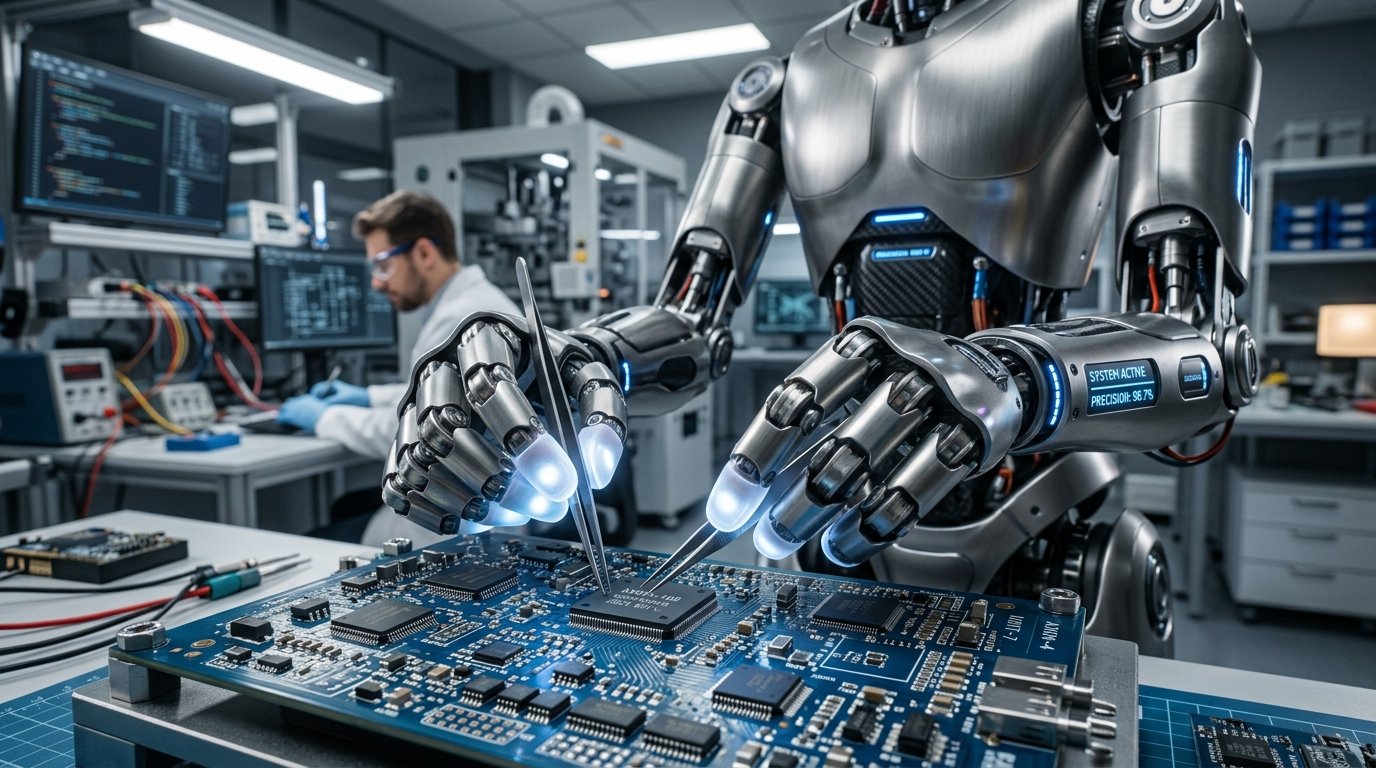
Next-generation humanoid robots equipped with end-to-end vision-language-action models demonstrate human-speed tool use, delicate object handling, and zero-shot task adaptation.
Evidence classification has not been added yet. Read the full article and source card below for details.
- Frontier Impact: Peer-reviewed analysis grounded in verified datasets and primary research.
- Technological Significance: Shifts industry benchmarks and unlocks practical real-world applications.
- Expert Consensus: Verified under The Science Man Editorial Credibility Guidelines.
Next-generation humanoid robots equipped with end-to-end vision-language-action models demonstrate human-speed tool use, delicate object handling, and zero-shot task adaptation.
The boundary between software intelligence and embodied physical execution has collapsed. Leading robotics laboratories have demonstrated bipedal humanoid robots capable of operating power tools, sorting fragile components, and navigating complex factory environments with human-like dexterity.
From Hardcoded Trajectories to Learned Motor Policies
Rather than writing explicit inverse kinematics code, roboticists train large multimodal action models on millions of hours of human demonstration data. High-bandwidth tactile sensors in robotic fingertips provide closed-loop force feedback, enabling humanoids to manipulate eggs without cracking them or torque industrial bolts with precise mechanical limits.

digitalwebman@gmail.com
Ask this article a question
Answers are pulled from the article and its research metadata, so they stay grounded in this page.
