
Nobel Prize in Physics 2026: learn why Francis Halzen’s IceCube work revealed cosmic neutrinos, how the South Pole detector works, and the Physics Nobel winners from 2017 to 2026.
Evidence classification has not been added yet. Read the full article and source card below for details.
- Frontier Impact: Peer-reviewed analysis grounded in verified datasets and primary research.
- Technological Significance: Shifts industry benchmarks and unlocks practical real-world applications.
- Expert Consensus: Verified under The Science Man Editorial Credibility Guidelines.
Nobel Prize in Physics 2026: learn why Francis Halzen’s IceCube work revealed cosmic neutrinos, how the South Pole detector works, and the Physics Nobel winners from 2017 to 2026.
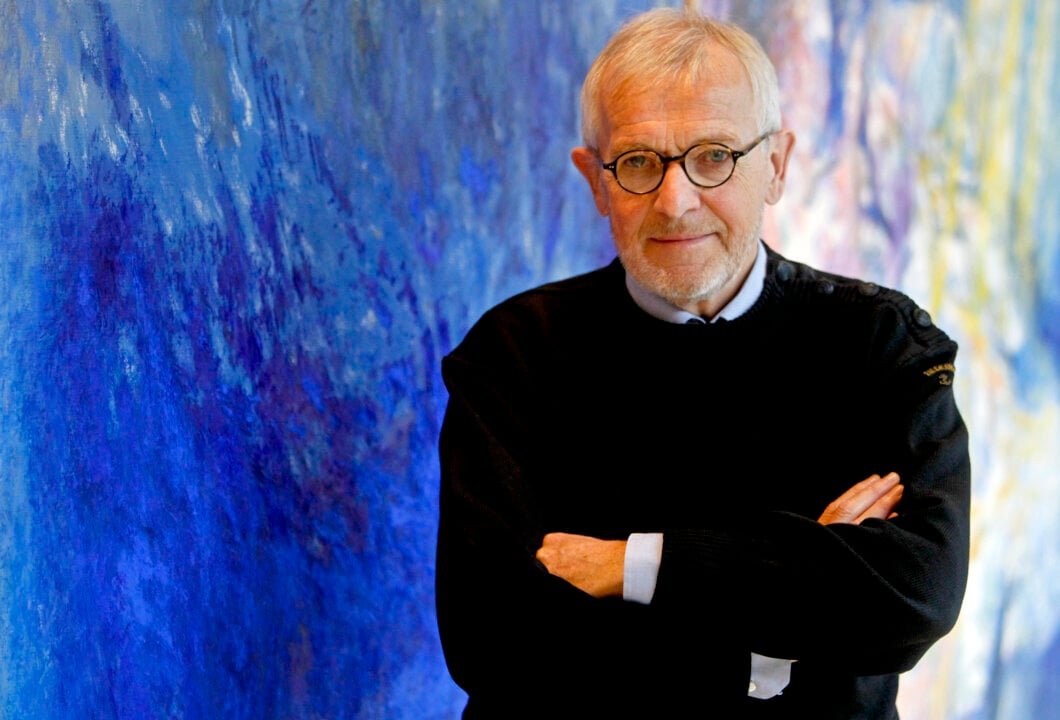
In brief: The 2026 Nobel Prize in Physics was awarded to Francis Halzen of the University of Wisconsin–Madison for decisive contributions to the IceCube Neutrino Observatory and the discovery of high-energy neutrinos of astrophysical origin. IceCube turned a cubic kilometre of Antarctic ice into a telescope for particles that cross the cosmos almost without interacting. The award was announced on 6 October 2026.
The universe sends Earth many kinds of messengers. Light is the one we know best: stars, galaxies and black holes shine across space, and telescopes collect those photons. But light can be absorbed, scattered or bent on its journey. A different messenger can travel through dense matter and magnetic fields while keeping a straighter path from its source. That messenger is the neutrino.
Neutrinos are so reluctant to interact that trillions pass through each of us every second without leaving a sensation. Detecting one is therefore a remarkable engineering challenge. Francis Halzen spent decades helping turn an audacious idea into a working observatory: place thousands of light sensors deep in the clear ice beneath the South Pole, then wait for the rare neutrino interaction that flashes blue.
The Nobel Prize in Physics 2026 recognizes that scientific vision and the observatory it helped make possible. IceCube did more than find elusive particles. It opened a new way to investigate the most energetic environments in the universe, from the vicinity of supermassive black holes to sources that astronomers are still trying to identify. Here is what the prize means, how the detector works, and how the physics Nobels of 2017–2026 trace a changing picture of the field.
 THE SCIENCE MAN
Nobel Prize in Physics 2026: at a glance
| Detail | Information |
|---|---|
| Award | Nobel Prize in Physics 2026 |
| Laureate | Francis Halzen |
| Affiliation listed by Nobel Prize | University of Wisconsin–Madison, USA |
| Official motivation | “for decisive contributions to the IceCube Neutrino Observatory and the discovery of high-energy neutrinos of astrophysical origin” |
| Announcement | 6 October 2026 |
| Research areas | Particle physics, astrophysics and neutrino astronomy |
| Observatory | IceCube Neutrino Observatory, at the geographic South Pole |
The award is for foundational work that helped make IceCube a reality and enabled its discoveries. It should not be read as a claim that one person built or operates the detector alone: IceCube is an international collaboration involving hundreds of scientists, engineers and technical staff. Halzen’s leadership and long-running scientific programme were central to that collective effort.
Who is Francis Halzen?
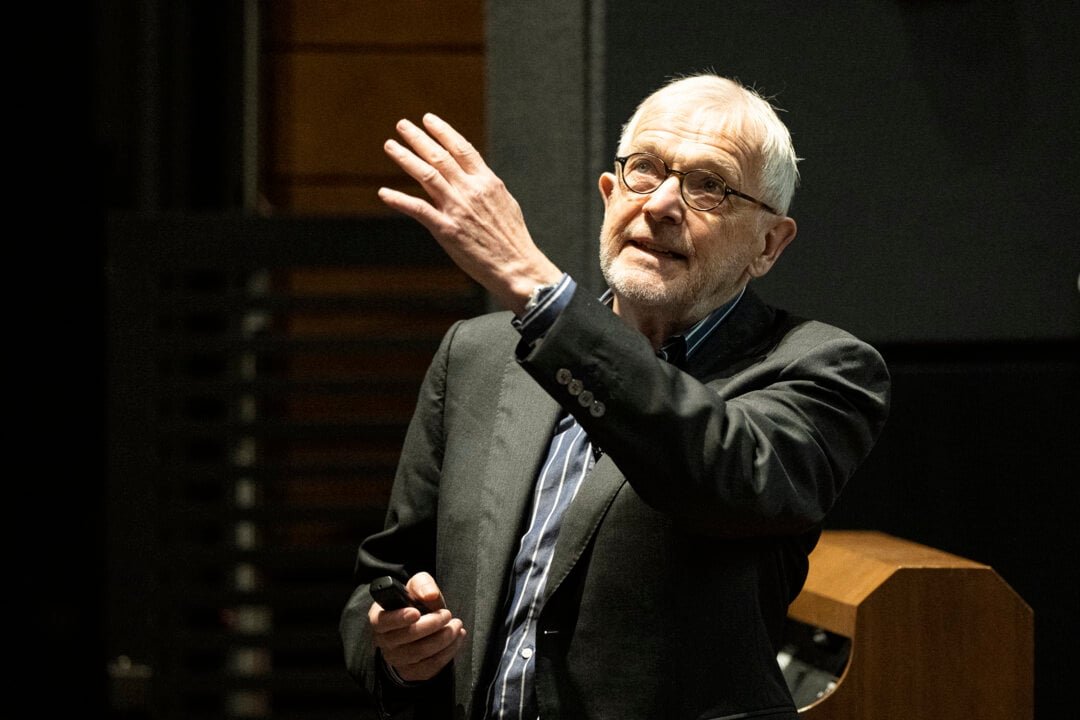
Francis Halzen is a Belgian-born particle physicist whose career has been closely tied to a deceptively simple question: could neutrinos tell us where the most energetic events in the universe happen? The Nobel Prize’s laureate facts list his affiliation at the time of the award as the University of Wisconsin–Madison. There he became a leading advocate for neutrino astronomy, a field that asks what we can learn by detecting neutrinos arriving from beyond Earth.
In the 1980s, the idea of building a very large neutrino detector in natural water or ice was still a proposal on the edge of experimental physics. Neutrinos are abundant but almost invisible. A detector made of ordinary laboratory equipment would be too small: a neutrino usually passes straight through. A much larger target increases the chance that one will occasionally collide with an atom and produce charged particles. Those particles can then emit a faint flash of Cherenkov light.
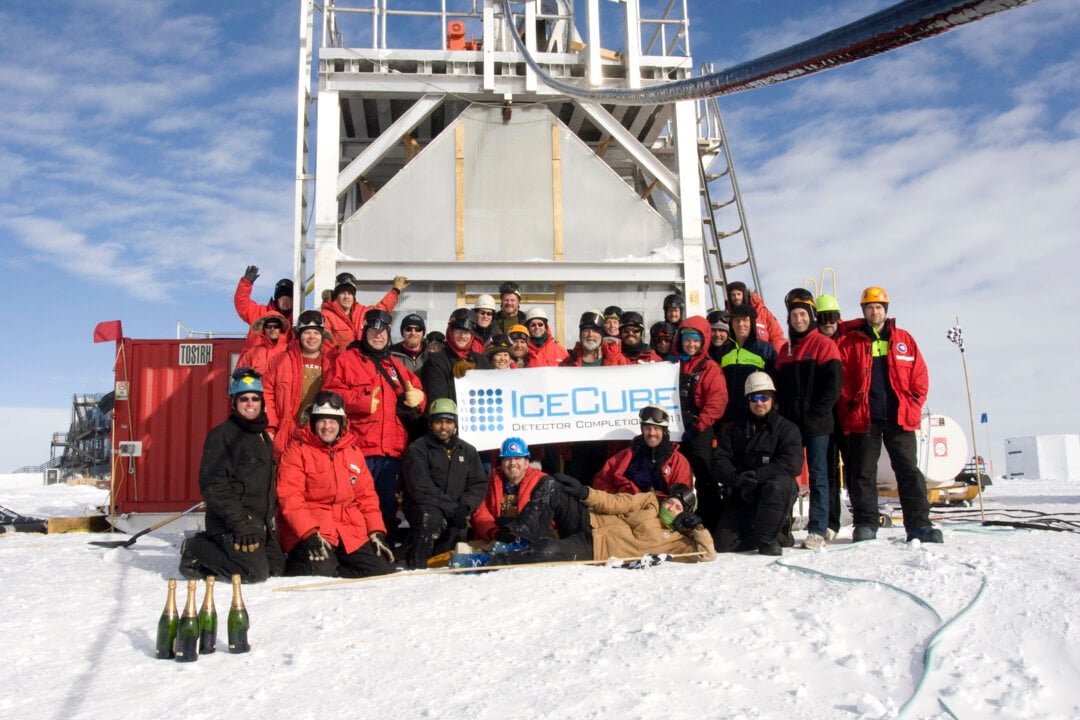
Halzen helped develop the case for using the deep, clear ice at the South Pole as that target. The proposal was ambitious in scale and time. It required drilling deep holes in the ice, lowering sensitive optical modules on long strings, building reliable electronics that could operate in extreme cold, and learning the optical properties of the ice well enough to interpret each flash. The observatory was constructed in stages; the full IceCube detector was completed in 2010.
 THE SCIENCE MAN
That long development matters. Big scientific instruments rarely begin with a dramatic discovery. They begin with a physical principle, a design that might work, years of tests and a team prepared to solve problems that do not yet have standard solutions. Halzen’s work helped bring together particle physics, astrophysics, Antarctic logistics and detector engineering around a single goal: use neutrinos to explore the cosmos.
Why did Francis Halzen win the Nobel Prize in Physics?
In direct terms, the Nobel Committee recognized Halzen’s decisive contributions to the IceCube Neutrino Observatory and its discovery of high-energy neutrinos with astrophysical origins. In everyday language, the prize honours work that made it possible to detect neutrinos produced by powerful sources outside our solar system and to establish that these particles can be used to study the universe.
For a long time, astronomers mainly observed cosmic objects through electromagnetic radiation—radio waves, visible light, X-rays and gamma rays. Cosmic rays also reach Earth, but their electric charge makes their paths curve in magnetic fields, which can obscure where they came from. Neutrinos have no electric charge and interact very weakly. If a distant accelerator produces them, they can travel immense distances carrying information about their source and direction.
IceCube’s discovery of a flux of high-energy astrophysical neutrinos established neutrinos as a practical astronomical messenger. Follow-up observations have associated some neutrinos with particular cosmic sources, while many detected events remain difficult to trace to a single object. The field is still developing: a neutrino signal can be rare, and confirming a source may require observations from many instruments and over long periods.
The breakthrough is therefore both a discovery and a method. IceCube showed that a detector on this scale can record enough events to study the high-energy universe statistically and, in some cases, point back toward individual sources. That changes the questions researchers can ask about cosmic rays, black holes and extreme environments.
What is the IceCube Neutrino Observatory?
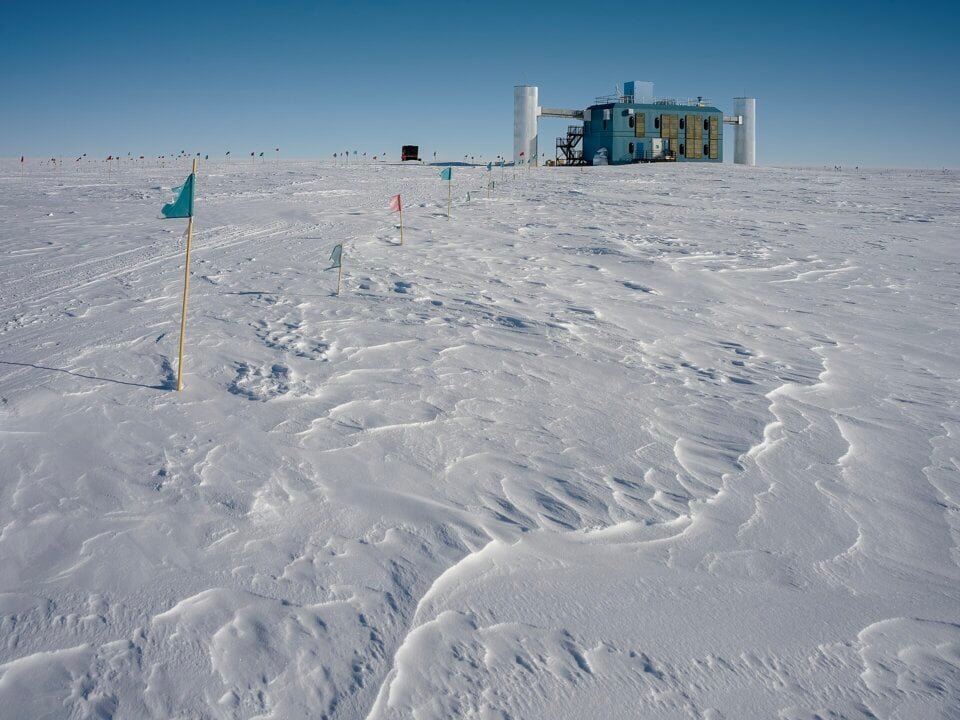
IceCube is a neutrino telescope built into roughly one cubic kilometre of Antarctic ice near the geographic South Pole. Its main detector uses 5,160 digital optical modules arranged on 86 vertical strings. The modules sit deep below the surface, where the ice is dark and protected from much of the surface noise. A smaller, denser subdetector called DeepCore improves sensitivity to lower-energy neutrinos, and IceTop instruments the surface above the main array.
The ice is not simply a place to bury equipment. It is part of the detector. When a neutrino interacts with an atom in or near the instrumented volume, the collision can create a charged particle, such as a muon. If that particle moves through ice faster than light travels through the same material, it emits Cherenkov radiation: a faint cone of blue light, analogous in shape to a sonic boom. The optical modules record the timing and brightness of the photons.
Computers combine signals from many modules to reconstruct the event. A long, clean track often indicates a muon travelling through the detector and can provide a useful estimate of the particle’s arrival direction. Other interactions produce a more compact cascade of light. The pattern is not a photograph of the original neutrino; it is evidence from which scientists infer its likely direction, energy and interaction type.
There is an important background to remove. Cosmic rays striking Earth’s atmosphere produce showers of secondary particles, including neutrinos. IceCube researchers use event direction, energy and other observables to distinguish atmospheric events from the harder-to-find astrophysical population. The Earth itself can help: for some analyses, scientists look for neutrinos that have passed through the planet, while accounting for the fact that the most energetic ones can be absorbed more often.
 THE SCIENCE MAN
The South Pole provides a vast, naturally occurring detection medium and a stable platform for a research station. Its remote setting also brings practical challenges: equipment must be transported, installed and maintained in a place with severe cold and a short field season. IceCube’s design turns those constraints into a scientific instrument that continues to observe the sky around the clock.
What are neutrinos—and why are they called ghost particles?
Neutrinos are fundamental particles with no electric charge and very small, non-zero masses. They are produced in nuclear reactions, including those in the Sun, in radioactive decays, in interactions in Earth’s atmosphere and in violent astrophysical environments. There are three known flavours—electron, muon and tau neutrinos—and neutrinos can change from one flavour to another as they travel, a phenomenon called oscillation.
The nickname “ghost particle” captures how rarely a neutrino interacts with matter. It is an analogy, not a special category of particle. A beam of neutrinos can pass through enormous amounts of material with most particles leaving no trace. That is why detectors need huge volumes, very sensitive sensors and careful methods for separating genuine signals from noise.
Neutrinos are not literally undetectable, nor do all neutrinos have the same energy. Solar neutrinos are comparatively low in energy; the astrophysical neutrinos IceCube is designed to study can carry vastly more energy. The energy helps researchers learn about the processes that produced them, but it also affects how far they can travel through matter and how much light their interactions create.
What is neutrino astronomy?
Neutrino astronomy uses neutrinos to study objects and events in space. It complements astronomy based on light. A photon may be absorbed or redirected along its way; a neutrino can escape from dense regions and travel in a nearly straight line. When a detector can determine its direction, researchers can compare that information with observations from telescopes that see radio, optical, X-ray or gamma-ray signals.
This is called multi-messenger astronomy when different kinds of signals are studied together. The messengers do not always arrive with equal strength, at the same time or from a source that is easy to identify. A neutrino alert can prompt observatories around the world to look for a changing object. A matching flare or other signal can strengthen the case that a particular source produced the particle.
Neutrinos can help investigate cosmic-ray origins because both may be produced in energetic particle collisions. Unlike charged cosmic rays, neutrinos are not bent by magnetic fields. Their arrival directions can preserve clues about where they were made. This does not mean every neutrino gives a clear address: detector resolution, backgrounds and the scarcity of events all limit what can be concluded.
How does one flash become a clue about a distant galaxy?
A neutrino event is reconstructed from timing, not from a single bright flash. Each optical module has a clock, and the detector records which sensors registered photons and when. A reconstruction program compares those measurements with possible particle paths through the ice. For a track-like event, the sequence of hits can constrain the direction from which the muon travelled; the muon’s direction is often close to that of the parent neutrino, though not perfectly aligned. For a cascade, the light is more compact and the energy estimate can be useful even when the direction is less precise.
The detector team must also understand the ice. Tiny dust layers and the orientation of ice crystals affect how light scatters and travels. Calibration studies map these properties so that a photon arriving late because it scattered is not mistaken for a longer path or a different particle direction. Instrument response, background rates and statistical uncertainty all enter the analysis. A candidate source is credible only when the data are unlikely to be explained by known backgrounds and the uncertainty is reported honestly.
Once a candidate event is reconstructed, IceCube can distribute an alert so that telescopes and other observatories can search the same region. A follow-up may find a flare or a transient object, or it may find nothing conclusive. Both outcomes matter: a match can sharpen a source hypothesis, while a non-detection can rule out or constrain some models. This is how an individual neutrino becomes one piece of a larger scientific argument rather than a standalone claim.
A global observatory built through collaboration
IceCube operates at the South Pole, but its science is global. The detector depends on people who design sensors, drill and deploy equipment, model Antarctic ice, monitor the instrument, build software and analyse events. Researchers at universities and laboratories around the world compare methods and scrutinize results. Halzen’s prize recognizes his decisive contributions and scientific leadership within that larger effort; it does not erase the collaboration behind the observatory or suggest that one person made every component.
That distinction is useful when reading any science award. A Nobel Prize highlights discoveries and influential contributions, but modern experimental physics often depends on teams, infrastructure and years of accumulated work. The individual laureate may have proposed a key direction, organized a programme or helped secure the instrument that made a new observation possible. The measurement itself still rests on the work of many people and on evidence that other scientists can examine.
What IceCube has revealed—and what remains uncertain
IceCube has established a diffuse flux of high-energy neutrinos coming from beyond the atmosphere, demonstrated the promise of real-time alerts, and contributed to the identification of likely neutrino-emitting environments. Researchers have reported evidence linking high-energy neutrinos to the blazar TXS 0506+056 and later identified neutrino emission from the active galaxy NGC 1068. IceCube has also reported neutrino emission associated with the Milky Way. Each result is evaluated through statistical analysis and follow-up work; the strength and interpretation of a source association depend on the data and analysis in question.
A blazar is an active galaxy whose central supermassive black hole powers a jet aimed roughly toward Earth. NGC 1068 is another active galaxy, viewed at a different orientation. These are important clues, not a complete map of all cosmic neutrino production. Scientists still want to know which classes of objects dominate the flux, how particles are accelerated to extreme energies, and how neutrinos relate to cosmic rays and gamma rays.
 THE SCIENCE MAN
New detector upgrades aim to improve sensitivity and event reconstruction. IceCube-Gen2 is a proposed expansion intended to enlarge the instrumented volume and increase the number of detectable astrophysical neutrinos. These plans reflect a broader lesson: when a new observational window opens, better instruments can turn rare first detections into a more detailed population study.
Nobel Prize in Physics winners, 2017–2026
The Physics Nobel over this decade has moved across very different scales: ripples in spacetime, ultrafast laser pulses, planets around other stars, black holes, complex systems, quantum information, machine learning and now neutrino astronomy. Here is the decade’s sequence. The 2026 award is included as announced; the official Nobel list for earlier years confirms the laureates and prize descriptions.
| Year | Laureate(s) | Recognized work |
|---|---|---|
| 2017 | Rainer Weiss; Barry C. Barish; Kip S. Thorne | Decisive contributions to the LIGO detector and observation of gravitational waves |
| 2018 | Arthur Ashkin; Gérard Mourou; Donna Strickland | Optical tweezers and high-intensity, ultra-short laser pulses |
| 2019 | James Peebles; Michel Mayor; Didier Queloz | Theoretical discoveries in physical cosmology; an exoplanet orbiting a Sun-like star |
| 2020 | Roger Penrose; Reinhard Genzel; Andrea Ghez | Black-hole formation and discovery of a supermassive compact object at the Milky Way’s centre |
| 2021 | Syukuro Manabe; Klaus Hasselmann; Giorgio Parisi | Physical modelling of Earth’s climate, climate variability and complex physical systems |
| 2022 | Alain Aspect; John Clauser; Anton Zeilinger | Experiments with entangled photons, Bell inequalities and quantum information science |
| 2023 | Pierre Agostini; Ferenc Krausz; Anne L’Huillier | Experimental methods generating attosecond pulses to study electron dynamics |
| 2024 | John J. Hopfield; Geoffrey Hinton | Foundational discoveries and inventions enabling machine learning with artificial neural networks |
| 2025 | John Clarke; Michel H. Devoret; John M. Martinis | Macroscopic quantum-mechanical tunnelling and energy quantisation in an electric circuit |
| 2026 | Francis Halzen | IceCube and the discovery of high-energy neutrinos of astrophysical origin |
 THE SCIENCE MAN
The list is not a straight march toward one subject. It shows how physics depends on different ways of observing and modelling nature. LIGO made gravitational waves measurable. Laser advances opened shorter time scales. Exoplanet discovery changed the study of planetary systems. Climate and complexity prizes recognized the power—and limits—of models for systems with many interacting parts. Quantum experiments made foundational ideas testable and useful. The 2024 prize recognized machine-learning foundations developed using concepts from physics; the 2025 award returned to carefully controlled quantum behaviour in an electrical circuit. IceCube’s story adds a new messenger: particles that traverse the universe almost untouched.
For readers comparing the winners, the table also shows that “physics” is not limited to equations about matter in a classroom. It includes designing an instrument sensitive enough to measure a passing wave, learning to control light on tiny time scales, testing the behaviour of entangled systems and turning a vast natural environment into a detector. The common thread is evidence: a model, experiment or instrument changes what can be observed, and the result must survive careful checks.
Why the 2026 prize matters to students and to India
For students, Halzen’s work is a reminder that an important scientific idea may need several generations of engineering before it becomes a measurement. The IceCube story touches particle physics, astronomy, materials science, data analysis, software, electronics and logistics. It offers a clear example of how experimental science works: define the signal, understand backgrounds, calibrate the instrument, quantify uncertainty, collaborate openly and revise conclusions when evidence changes.
For Indian students, the prize is relevant because particle physics and astronomy are international enterprises with many kinds of entry points. India has a strong science and engineering ecosystem and participates in major international research collaborations across fields. IceCube’s award does not mean India directly built or operated this observatory; it shows why fundamental research, detector expertise and cross-border collaboration matter. Students can explore physics, instrumentation, computing, statistics, electronics and research communication as connected career paths.
Neutrino astronomy is also a useful lesson in patience. A detector may collect years of data before a rare event becomes persuasive. The work is not only about a spectacular discovery; it is also about the many careful decisions that make a discovery trustworthy.
What could neutrino astronomy discover next?
Future observations could help scientists determine which astrophysical objects produce the largest share of high-energy neutrinos and how their environments accelerate particles. Coordinated observations may reveal whether a neutrino arrived during a flare, explosion or other transient event. Researchers also hope to use neutrinos to test models of cosmic rays, study particle interactions at energies that are hard to reproduce on Earth, and probe dense regions hidden from ordinary telescopes.
These are research goals, not settled predictions. Neutrino data may provide clues about dark matter in some models, but IceCube has not established dark matter as the source of its astrophysical neutrinos. A larger detector could improve sensitivity and source localization, while new analyses may extract more information from existing observations. Progress will depend on evidence, not on the appeal of a particular theory.
Frequently asked questions
1. Who won the Nobel Prize in Physics 2026?
Francis Halzen, affiliated with the University of Wisconsin–Madison, received the 2026 Nobel Prize in Physics for contributions to the IceCube Neutrino Observatory and the discovery of high-energy neutrinos of astrophysical origin.
2. Why did Francis Halzen win the Nobel Prize?
The Nobel-recognized work helped establish IceCube as a large neutrino observatory and enabled the discovery of high-energy neutrinos produced beyond Earth. These particles created a new observational route into the high-energy universe.
3. What is the IceCube Neutrino Observatory?
IceCube is a neutrino telescope embedded in about one cubic kilometre of Antarctic ice at the South Pole. Thousands of optical sensors record the faint light made when neutrinos occasionally interact with matter nearby.
4. What are neutrinos?
Neutrinos are electrically neutral fundamental particles with tiny masses. They are produced in nuclear reactions and in cosmic environments, and they interact so weakly with matter that most pass through Earth without colliding.
5. Why are neutrinos called ghost particles?
“Ghost particle” is an informal nickname for how rarely neutrinos interact with matter. They are detectable with large, sensitive instruments; the nickname does not mean they are supernatural or impossible to measure.
6. How does IceCube detect neutrinos?
A neutrino interaction can create a charged particle that emits Cherenkov light in the ice. IceCube’s digital optical modules record the timing and brightness of that light, and researchers use the pattern to estimate the event’s energy and direction.
7. Where is IceCube located?
The observatory is at the geographic South Pole, within the Antarctic ice beneath the U.S. Amundsen–Scott South Pole Station. The detector uses deep ice as its target and light-transmitting medium.
8. Why is the South Pole useful for neutrino research?
The South Pole offers a vast volume of deep, clear ice that can serve as a detection medium. The remote location brings difficult logistics, but it also provides a stable research base and a large instrumented volume.
9. What are high-energy astrophysical neutrinos?
They are neutrinos with very high energies that originate in cosmic environments outside Earth’s atmosphere. Their energies and arrival directions can help researchers investigate energetic sources such as active galaxies.
10. What is neutrino astronomy?
Neutrino astronomy studies space using neutrinos as messengers. Because neutrinos are electrically neutral and weakly interacting, they can carry information from regions that may be difficult to examine with light alone.
11. What did IceCube discover?
IceCube established a diffuse flux of high-energy astrophysical neutrinos and has reported evidence associating neutrinos with sources including TXS 0506+056 and NGC 1068. Researchers continue to test source associations and map the population.
12. Who won the Nobel Prize in Physics in 2025?
John Clarke, Michel H. Devoret and John M. Martinis shared the 2025 prize for the discovery of macroscopic quantum-mechanical tunnelling and energy quantisation in an electric circuit.
13. Who won the Nobel Prize in Physics in 2024?
John J. Hopfield and Geoffrey Hinton shared the 2024 prize for foundational discoveries and inventions that enable machine learning with artificial neural networks.
14. Where can I find the official Nobel Prize information?
The Nobel Prize’s official 2026 Physics summary, laureate facts, announcement and photo gallery are available at NobelPrize.org. IceCube’s observatory pages provide technical and research updates.
Final thoughts: learning to listen to the universe
The Nobel Prize in Physics 2026 is not simply about detecting an elusive particle. It recognizes a long scientific effort to build a new kind of telescope—one that listens for the rare flashes left by neutrinos rather than collecting starlight. IceCube has shown that the ice beneath the South Pole can become a window onto distant cosmic accelerators, while also revealing how much of the universe remains unexplained.
Francis Halzen’s contribution is part of a larger story of collaboration, engineering and persistence. The next chapter will depend on more observations, more precise detectors and careful interpretation. Each neutrino is a small signal with a long journey behind it. Together, those signals are helping researchers ask where the universe’s most energetic particles are born.
Sources and further reading
- Nobel Prize in Physics 2026: official summary
- Francis Halzen: Nobel Prize laureate facts
- Nobel Prize popular information: IceCube and neutrinos
- IceCube Neutrino Observatory: about the detector
- IceCube research and news
- Nobel Prize: all Physics laureates
Photo credits are listed under each image. The images are presented as editorial illustrations of the Nobel announcement and IceCube research; The Science Man is not affiliated with the Nobel Foundation.

digitalwebman@gmail.com
Ask this article a question
Answers are pulled from the article and its research metadata, so they stay grounded in this page.
